A Letter To David Matzke

The beautiful is always bizarre–-Baudelaire

I tell you, David,
poetry ought to be shocking,
and poets ought to be dangerous people.
In whatever country, honest feeling is always
shocking and dangerous.
Anyone true to the heart can simply enough and at
any time be both.

But for their contempt we’ve ourselves to blame.
We’ve been cowardly.
We’ve made the stuff so cheap
begging their love
that poets are poor people
from wearing out the money of never was
passing it back and forth among themselves.

Rub the truth in their faces!
What is the point of being a poet, anyway,
if you can’t be a kind of prophet?

Hold their nose to the stink,
Say “look, this is it!
We are here by ourselves,”
say “there’s no kind uncle,
you will have to furnish the kindnesses out of your
own pocket.
If you see that, nothing can hurt you!
Stop kissing essences. Learn to respect
your essential rumpy importance.
And for God’s sake, don’t mistake my words for food,
when they’re nothing but spoons.”

Say with whatever gestures are customarily indecent
and the wildest possible musical accompaniment
“The sky will not move
for buckets of moonlight and French quotations.”
While they’re watching you chant like a demon priest,
kick away all those roses covering the cesspool.

How else make clear
that if there’s a reason
we bawl these songs to ourselves
as we push this stone to nowhere
for no apparent reason,
the reason is too simple to be believed–
like the snake swallowing his tail.

That music is useless,
That music is to eat and to make love and to make music,
one’s own music.
That music is music.
Why, this alone, if they could understand it,
would overturn all their systems.

Shout something simple and sensible.
For instance, that nothing done in boredom
is a human accomplishment.
They’ll think you’re talking about leisure
or the family cookout. Make it clear you’re not.
Don’t worry. If you brandish it seriously or humorously
and go ahead and shout it in the street,
they’ll only mistake you for an arsonist or a communist.
And smelling out the truth with their fear,
roll you in the garbage to comfort their taught lies.
You have to understand them.
They’ve only this one poor fence against accepting the nature
of themselves
and they truly fear it.
They’ll never suspect you’re a poet.
They cannot allow you a worthwhile reason
to deserve to be punished.
So they won’t punish you for the right reason.

When you speak of love,
they’ll try to pretend you mean Cleopatra
or some other anal-vaginal queen.
And only two or three will dare recognize
your corrosive subversity.
Make sure they have to make fools of themselves
to ignore the difference.

Are you afraid?
If you’re not, there’s something wrong with you!
To tell them what they care for most
is as relevant to their souls
as the sugar level of the urine of pregnant beetles?
But you ought to be more afraid of dying without
having tried!
What is important except to be what you are?
Make them call out the cops if possible.
Poetry had better be shocking or shut up.
What earthly good to say
that Spring will be around again next year ?

© by Andrew Glaze, 1963, from Damned Ugly Children.

ABOUT DAVID MATZKE:

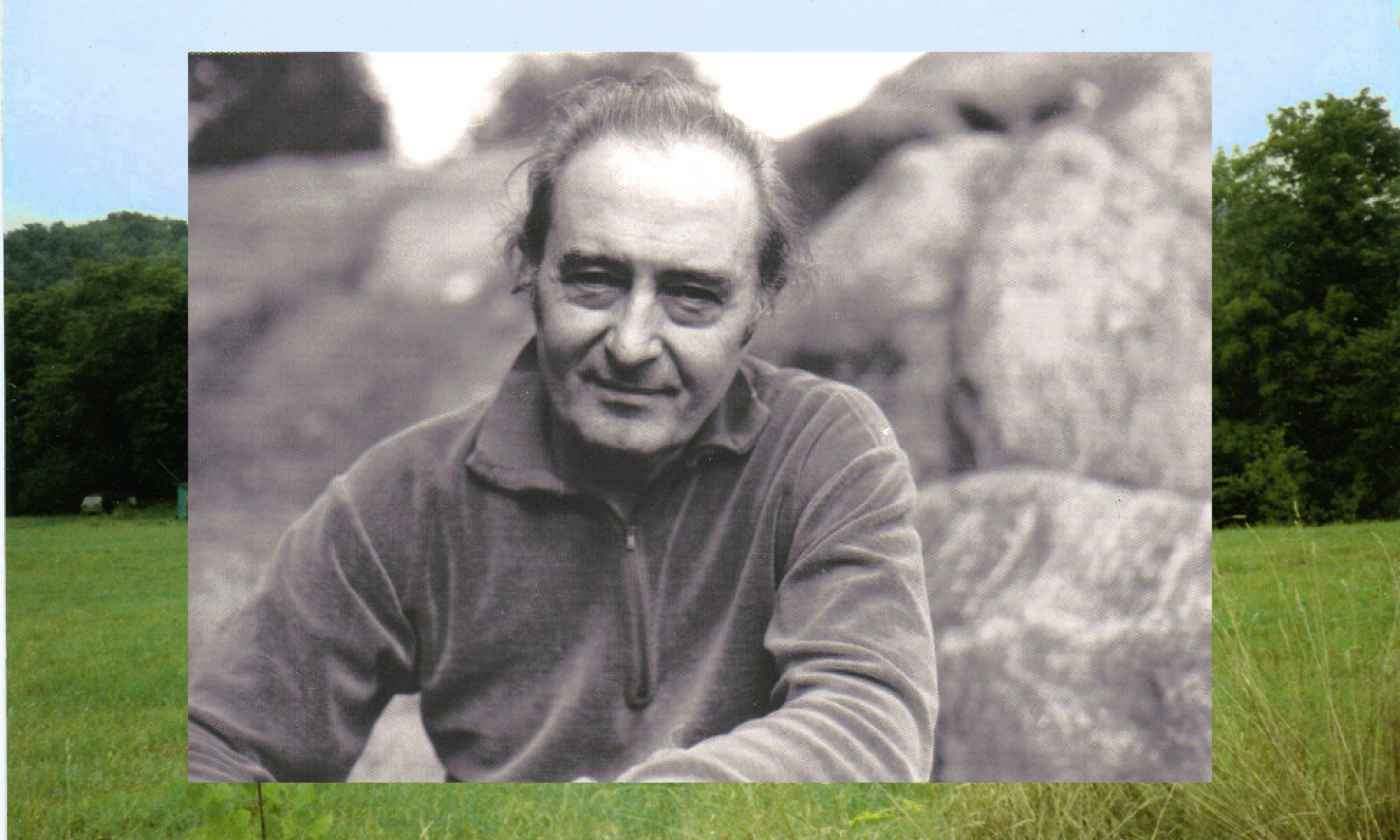
The first time I met David Matzke he was called “Jeff Crawford”, had a wife named Connie, a young son, and I was 7 years old.  In 2006, my mother reminded me that Jeff and Connie originally came into our lives through her.

In 1957, our first true apartment in Manhattan was the ground floor rear garden flat of a brownstone on 102nd Street. We were half a block from Riverside Drive. I had the only bedroom as well as direct access to the backyard. A friendly artistic black couple named Oscar and Zizi lived directly above us. After years of trying to treat blacks in the South as equals, only to find that the blacks were terrified to accept the invitation for fear of outside retribution, my parents were ecstatic to be able to freely strike up a friendship.

On weekdays, my father took the subway to work at British Tourist Authority after dropping me off at school in Greenwich Village, and my mother was the Superintendent of our building. In exchange for using the repair and maintenance skills she’d learned while she and my father renovated our house in Birmingham, we had free rent. Very early in their marriage my mother said she’d complained “You get to do all the fun stuff”, because cooking, cleaning, and laundry never held much interest for her. He listened, and they agreed to split the jobs between them. Years later, she taught me how to dry wall and helped me renovate parts of my home. Most memorably, in 1989, when she decided I needed to learn how to change the oil of my car, she placed a huge piece of cardboard on the ground under the engine, gracefully slid on her back to get to the oil tank, and began to demonstrate. All while wearing a pale pink pencil skirt suit, stockings, and high heels. My father became the person who dragged me off to buy good hairbrushes, to the dermatologist for my skin, and made sure I was brushing my teeth regularly. But I digress…

Every evening, after my father came home, my mother would head off to her second job as a chorus girl. She was performing in an off-Broadway comedy spoof called, “Best of Burlesque”. TV comedian Tom Poston was the headliner, and retired burlesque stripper Sherry Britton was the narrator. My mother was one of “Nelle’s Belles” and with great delight the producers gave her the stage name “Sugar Glaze”. “Lilly White” was another cast member. Nelle Fisher, the only dancer on the Captain Kangaroo TV Show, was the choreographer. For years, Nel taught movement/dance lessons in the studio building attached to Carnegie Hall. I remember sitting and watching my mother in one of her group classes during this time. After that, whenever the Dancing Grandfather Clock appeared on Captain Kangaroo, I knew it was Nelle Fisher.

Every weekend my mother would bring her evening job costume home to hand wash and hang it up to dry. It was a sort of flesh colored leotard with a poufy tutu ruffle around the hips and butt, a bra sewn inside, many sequins, and white elastic shoulder straps that had been dyed with facial foundation makeup to make them blend in with skin tones. I was fascinated.

There is a 2008 New York Times obituary for Sherry Britton that states, “Ms. Britton was the onstage narrator of “Best of Burlesque”, a two-hour show at the Carnegie Hall Playhouse, which also starred an eye-rolling Tom Poston as the top banana, or star comedian. With poker-faced chorus girls singing off-key and rhythmically chewing gum, the show spoofed what was by then a lost art form.”

Yes, I can proudly state that my mother was one of those poker faced, rhythmically gum chewing, off key singing and dancing girls. In 2004, when she came across an out of print encyclopedia of Broadway and Off-Broadways Shows, she showed it to me, gleefully pointed out the name “Sugar Glaze” in the list of performers, and burst out laughing.

It was during the run of “Best of Burlesque” that Jeff Crawford’s wife, Connie, became friends with my mother. Connie was one of the wardrobe ladies. When we moved to Greenwich Village a year later, my father met Connie and her husband Jeff. They were both contemporary art painters. Interestingly, my mother later said she’d always felt that Connie was the more talented of the two. However, she never saw any of Jeff’s later work. Somehow my father and Jeff struck up a friendship.

In the ensuing years, my parents divorced, my father remarried, and we moved to 9th Avenue and 53rd Street on the West Side of Manhattan. We were near the Broadway Theater District and Lincoln Center. Then one day my father came home from work and told me he’d bumped into Jeff …except that Jeff was now “David Matzke”. It seemed that he’d used the name Jeff Crawford to avoid jail, but eventually had been tracked down and sent to serve a prison term in upstate New York. Now he was out, back in Manhattan, back with Connie, had a second son, and they lived around the corner from us. At some point, I remember my father explaining that David had become addicted to codeine cough syrup, and had broken into a home, or possibly multiple homes, to search the bathroom medicine cabinet.

Since I was an art major at the High School of Music & Art, in an effort to help them financially my father asked Connie to give me oil painting lessons for a while and David built me a wooden easel. The close proximity brought David to our house regularly. At times he’d visit for long therapeutic talks with my father, and I’d find them ensconced in our living room. On other days he’d bring paintings. Our 9th Avenue and 53rd Street apartment was what is described as a “railroad flat”. This is because it was the length of the entire building and you had to walk through every single room to get to the very front end or the very back end, just like you do on a train. As a result, we had loads of blank wall space, which David did not. And so for the entire duration of the 1960’s our apartment became an ever changing art gallery of David’s paintings. He’d hang them to dry and then come to replace them with new ones. To this day, the smell of oil paint and linseed oil immediately takes me back to 803 9th Avenue, at 53rd Street. It was a win-win situation. We had constantly changing art and he had a safe showplace.

Then one day David screwed up and everything fell apart.
It all started because my father bumped into Zizi, our artistic black female friend from our days living on 102nd Street. It turned out that she’d also moved into our neighborhood! So he invited her over, and David stopped by while she was visiting and was introduced. I remember arriving home from school that day and greeting them both. The problem was that Zizi and David continued the acquaintanceship and ended up having an affair. When his wife Connie found out she kicked David out. It’s hard to remember all the details now, but I’m pretty sure I remember a half-hearted suicide attempt – it may or may not have been Connie, something about a child falling off a fire escape from a lower floor, and an eviction notice, but that wasn’t even the full extent of it. What I do remember is relating a lengthy dramatic saga to my best friend at school and closing with, “If anybody had brought a movie script like this to a Hollywood producer, they’d have said it’s too unrealistic.”

So David left the city, and returned to his birth state of California. It proved to be an artistic rebirth for him. He eventually came back to Manhattan producing paintings in a new style with vibrant colors; a result of mixing his own paint and painting in the California sun. We still have one of his paintings from this period. It’s called “Fire Birds”. My personal favorite was a painting with blue flowers that an acquaintance of my father’s purchased.

I’ve always remembered something my father once related to me. He said that David had vivid memories of being a baby, and young child, who was obsessed with painting his crib mattress and walls. It was a constant issue and struggle with his parents, because, lacking any other medium to use, the only “paints” available were his own feces. Clearly, David was born to be an artist from day one. It was in every fiber of his being.

Somehow around this time, David met his next wife, Lisa, whom we all liked very much. Young, but with an old soul, she was a lovely person. They lived in Brooklyn Heights at the time and stayed in touch with us. I remember sitting on the fire escape just outside their kitchen window one evening and enjoying chatting with her brother when he visited from their hometown of Charleston, SC.

Unfortunately and tragically, when David & Lisa’s first child was born, he had cancer at birth and died not long afterwards. The shock sent them both into a spiral of depression, they parted for a period of time, and Lisa returned to Charleston. After awhile, David joined her there and they eventually had two daughters.  David moved to New Orleans when they agreed to separate at a later point, but they reunited again in 1977 and had a son while living in Louisiana. 

In 1981 David died in a mysterious fashion.  His family tells me that he went off on a motorcycle ride to cool off after a heated argument with Lisa, and never returned.  It was two years before they discovered what had happened to him.  in 1983, the police found his remains in a wooded area on the other side of a nearby lake and used dental records and his wallet to identify him.  Piecing the evidence together they concluded that his high blood pressure must have caused some sort of heart issue, he didn’t have his medication with him, and he died after dragging himself off the road.  His daughter tells me that Lisa always felt in her heart that he must have died, and felt certain that he would never have willingly abandoned them.  In 1983 Lisa called my father and stepmom to tell them the news.  

ABOUT THE POEM:

The poem proved to be a problem child, not unlike the title subject.

In 1964, if anybody had predicted the future and warned my mild mannered, non-confrontational, kind, witty, intellectual, and bow tie wearing father, that this one single poem would create a firestorm of problems for him that would linger for years afterwards, I believe he might have reconsidered publishing it at all, much less in his very first book. Although he did later say it was one of the best poems in the book, in his opinion. The original version was actually titled, “To Jeff Crawford” and first appeared in a small Alabama published poetry booklet titled The Token.

The poem immediately attracted reviewer’s attention, and they either hailed or hated it. William Packard, a publisher and a professor at New York University, loved it so much he used it as an example in his teaching textbook The Poet’s Dictionary: a handbook of prosody and poetic devices.

On the “Hater” side, fifteen years later in 1979, Harvey Curtis Webster still held a grudge when he reviewed The Trash Dragon of Shensi for Poetry Magazine. My father referred to this in 1985 during an interview with Steven Ford Brown.

“Brown: You once remarked that a poem from that volume, “A Letter To David Matzke” was quite misunderstood by most people. And that it still got you into trouble?

Glaze: “A Letter To David Matzke” was like a red flag to a bull to a lot of literary types, and to a lot of the literary movement, apparently because of its naïve calls for “honesty”. In that wing of poetry which believes most strongly in artifice, craft, technique, indirect allusion, tradition and various theories of semi-mystical inspiration or hermetic art, it was regarded as a rude and sophomoric Jeremiad. As recently as four years ago, I got a review in Poetry which totally ignored the book ostensibly under consideration (Trash Dragon) and made a violent attack on this poem. All of which is pathetic, since I’d written the piece as an aesthetic guide for no one except myself. I never even had the intention of stepping on anyone’s toes. The piece has been considered an apolgia for “beat” poetry, “confessional” work, overtly sexual content, and heaven knows what else. Things which did not interest me at all.  Most readers who objected, got angry so quickly they didn’t read much past “Poetry had better shock or shut up”.  Sense went out the window. Some reviewer mocked poetry with such pretensions which lacked incest, homosexuality or rape to keep it honest. It makes one wonder what poetry is to a lot of people. Something pretty petty, which deserves whatever death it chooses for itself.”

My father later revealed the full extent of his subsequent ostracism, and how he came to understand the source, in an email. The recipient was poet and writer Steven Conkle, a friend and fan.

“Dear Steve:

Now that’s what I would call thoughtful. EPOS! I don’t know when they went out of business, but it must have been decades. And I was relieved to find that I could still read the poems without wincing. (Referring to poems of his in the EPOS anthology.) Let me see. That was after my first book, and just before Tony Rudolf in London broke his own rule and printed something that wasn’t a translation.” (Referring to his poetry booklet “A Masque of Surgery”.)

“I was getting discouraged about ever getting a second book despite 30 or 40 great reviews.

I never discovered why till I went to a lecture in the village (NYC), and Richard Howard was introducing whoever it was. At the intermission he came up to me, which puzzled me, because I’d never met him. He said, “Sir, when I chair an event like this I always pick an intelligent face in the audience to talk to. In this case it was you. Do you mind my asking who you are?”

I replied “My name is Andrew Glaze”. His face flooded with astonishment, “You’re Andrew Glaze!” he said, then with a kind of horror “YOU’RE ANDREW GLAZE“! He backed away and avoided being anywhere near after that!

That was my introduction to how the poetic establishment operates underground and covertly to try to force people to write as they wish.”
(He then went on to mention additional names as part of a tightly knit “clique”.)

Lacking acceptance into the poetry equivalent of “The old boys club”, he determinedly forged ahead and managed to find his own path to publishers, magazines, and fans to share his poetry with.

Currently, what amazes me is the fact that, despite the obstacles he overcame to get his work published, and a very long bibliography of known published work, I still continue to discover new entries to add to it! Clearly, given a choice between writing and record keeping, my father always picked the former. In a poetic sense, it appears that I’ll be spending time with my father for many years to come as I search across the web and his papers for signs of further publications. Luckily, I don’t mind; along with Poet Laureates, I have librarian DNA in me. I tend to enjoy the challenge of the search.
Fire Birds adjusted
“Firebirds” by David Matzke (as seen from below). Property of the Andrew Glaze Estate.

1975 David Matzke's paintings
One of David’s paintings is on the wall to the right. Others are on the left and down the hallway beyond. The photo makes the painting look dark, but in reality it was not. I always thought of it as “The Chair”.  Photo property of The Andrew Glaze Estate.

The same chair painting is in the photo of me in 1966.

Two more of David’s paintings are on the walls in the photos below.

david matzke
David Matzke 1929 – 1983

img_20180430_0001.jpg
Original Cast Album cover, “Best of Burlesque”, 1958.

Dot circa 1958
Dorothy Elliott (Glaze) Shari. These professional theatrical “Head Shots” were made around the time of “Best of Burlesque”.

— E. Glaze

Alleluia

As I walk mornings down Bleecker Street,

I meet ten saints with filthy demands.

The tenements shout with holiness,

God reels by or sleeps on the curb,

at home everywhere in the wrecks and bars,

in the stale tobacco and business,

and everything that’s wild and absurd,

like madness with madness and holding hands.

I had rather ten faces than ten birds,

I don’t sense deliverance in a tree.

There is no impossible in lakes,

there is more miracle in a crowd

than in a Rocky Mountain or me.

There is more holiness in an eye

than in a scroll of holy words.

God’s here, thank God, in the market place!

Viva the Signor of warts and turds!


© by Andrew Glaze, 2015, from Overheard In A Drugstore.


In 2008, Pulitzer prize winning poet Galway Kinnell sent my father a letter stating that he loved this poem, and would always remember the final line.  They’d both taught at Bread Loaf Writer’s Conference within a year of each other, and would eventually appear on the A and B sides of a recording created by the wife of composer Alan Hovhaness. Betty Hovhaness was also from Birmingham and owned a record company called Poseidon Records.  She’d created it primarily to promote her husband’s work, but decided to record my father reading poetry and asked him who he would suggest for the flip side. He recommended Galway Kinnell, and she agreed.  

Many years later, when Kinnell died in October of 2014, my father kept a clipping of his New York Times obituary on the table beside his living room chair and grieved for several days afterwards.  Besides the fact that he admired his work, I believe it’s because he was so proud of the fact that Kinnell really liked his poem.

The poem “Alleluia” was originally titled “As I walk mornings down Bleecker Street”, and it began to develop in the late 1950’s when we moved to Greenwich Village at 173 Bleecker Street, on the corner of Sullivan.  “The Village” was vibrantly alive with creative arts in those days, but still had regular neighborhood stores. There was a laundromat at the bottom of our building, and a drugstore across the street. 

It wasn’t until 1993 that I discovered my father’s brother in-law fondly referred to him as “The first beatnik of Alabama”.  I have to admit, it was a surprisingly accurate description. Despite going off to work every day in a suit and bow tie, the mild mannered conventional exterior of my father hid an interior that longed for creative inspiration and supportive peers with similar goals.  That first Christmas my father decided he wanted a guitar, my mother asked for bongo drums, and I was presented with a tambourine so I wouldn’t feel left out although I had absolutely no clue what to do with it.  My mother also asked for oil paints and brushes. One day I came home from school and discovered she’d used them to create a swirly free form painting directly on a wall in our living room. As I’d been raised to NOT draw or paint on the walls, I remember being somewhat stunned.  Clearly my parents were adapting to Greenwich Village artistic life a lot faster than I was.  During this same time period, a block away from us at the Village Gate, Peter, Paul and Mary were performing on a regular basis, and nearby, at Washington Square Park, a pair of elderly mandolin players would entertain the strolling public pretty much every evening.  By 1960, half a block away, the musical “The Fantasticks” would launch into the first of what would eventually become a 42 year run at the Sullivan Street Playhouse.  I was attending the first and oldest progressive private school in Manhattan, on 12th street, and one of my classmates was the sole child of the late James Agee.  In 1957, my schools mandatory dress code was denim jeans and tee shirts, and boys and girls did everything equally. It was my mother who pushed for this form of education.  Oddly enough when I graduated and became a student at the High School of Music & Art, I went through a reverse rebellion and avoided jeans and slacks for four years.

Despite the fact that we lived in a bathtub in kitchen apartment, with a shared toilet in the hallway, life was pretty good, and certainly very interesting.  One afternoon my father came home and told me that he’d spent some time writing at Café Figaro.  It was one of no less than four cafes at the cross roads of Bleecker and MacDougal streets. Somehow he’d learned that it was a hub for writers and poets. He explained that the custom was to sit at a table while you worked on a written piece. When you felt you’d made progress you would simply stand up unannounced, read your work aloud, and sit back down again. I have no idea if anybody made comments, or “snaps”, but I’m fairly certain Alan Ginsburg was part of the scene at the time although my father never cared much for his poetry.

“Alleluia” is my father’s love letter to Greenwich Village and Manhattan, warts and all.  Neither of my parents ever regretted leaving Alabama for Manhattan. My mother said she felt at home the moment our Greyhound bus first came across the George Washington Bridge, and NYC provided my father with the supportive poetry world that Birmingham lacked at the time. My father returned to Alabama 44 years later, and found a vastly improved poetry scene in Birmingham, but both of my parents continued to love Manhattan until the day they died. 

—E. Glaze
Galway Kinnel blurred address

“Thanks for the review that your friend managed to get to me. Thank you even more for your poem “Alleluia” which I found very moving from first line all the way to the last line. I will remember your closing line: “Viva the signor of warts and turds!”  I hope you won’t let being eighty-eight stand in your way for more years of fruitful work. If I am ever in Alabama, I will look you up, provided you agree to do the same to me if you are ever in Vermont.”
Copyright of the Galway Kinnell Estate, property of the Andrew Glaze Estate.

12039700_10209699125823520_4170967706283998131_nCopyright of Poseidon Records.

Dot's wall painting
The wall painting my mother did at our apartment on Bleecker Street.  The photo is a bit faded, and the camera flash bulb is reflecting off of the rectangular shape.  In real life the colors were much brighter, the object on the lower left was greener, and the rectangular box was deep blue with yellow.  It was very 1950’s art style.
Property of the Andrew Glaze Estate.

Nijinsky

Bending up the stairs,
dance case swung to my shoulder to the back,
I looked one flight above and saw Nijinsky
sitting on the steps—I swear—
his thighs wide-stretched and huge,
facing me with wild, high cheekbones, V-shaped chin,
clinging over me like an angry Scaramouch.

His eyes burned with a hollow light,
and stared in mine like a curious grievance brought to bay.
Contempt drew down the corners of his mouth,
made ploughed contours over the ridges of his eyes.
—you are too gross to speak of—he seemed to accuse
—old clot of fifty-eight,
desecrating my youthful art—.

“Exercise!” I stammered.
How could I make the ridiculous word compose itself?
I writhed in the contumely of his eyes
with their ghostly fire,
so the truth came hurtling out
like a series of tours de reins.
“I pickpocket a taste of it, that’s all—for love.”

His face cleared as though with a blast of light.
He grinned, fading,
and I swear, left a fleeting thought
as the stairs grew stairs again
and a tiny wind blew,
—Nothing excuses anything—nothing—
but passion’s the most forgivable greed in a thief—.

© Andrew Glaze,1991, from Reality Street

This was the first poem ever published by Dance Magazine, August,1980.


What made my father decide to start ballet lessons at the age of 45?

In his youth my father played soccer and softball at school, skied, hiked and biked in France after WW2, and played golf and tennis in his 20’s. When we lived in Greenwich Village I watched him hit tennis volleys against a designated brick wall at a local playground. After we moved uptown to 53rd Street, he biked to and from work every day, and occasionally rode around in Central Park. 

I had been a ballet dancer since age 3. This was for two reasons.
One.  My mother noticed that I spent large parts of the day dancing around the house.
Two. She happened to read Agnes De Mille’s best-selling autobiography.
In it De Mille revealed that she’d led a tortured life, because she’d been denied ballet lessons as a child. My mother said she looked at me pirouetting around the room, went into full panic mode, and quickly enrolled me in The Lola Mae Jones School of Ballet. This was Alabama, and, yes, not only was there a genuine “Lola Mae Jones”, but she had a daughter with the same name, so there were actually TWO of them. My excitement was short lived. Even at the age of 3, I was worldly wise enough to realize that pretending to be a clock or a teapot had little to do with ballet, and I craved the real stuff.  By the time I was five I still wasn’t past the tea pot phase, and couldn’t handle another minute of pretending to be an elephant swinging my trunk. I retired.

THEN, we moved to Manhattan and my father’s cousin Hansel took me to see The New York City Ballet perform Balanchine’s version of The Nutcracker. I wanted to be one of the children in it, and by that spring I’d come out of retirement and auditioned for their school.  By September I was a student at the School of American Ballet.  My teapot days were over. Instead I had two Russian ballet teachers; one frequently terrorized us to tears, and the other was so sweet we took advantage of her. I soldiered on with determination.

However, my father’s own interest didn’t awaken until after he met and married my stepmom. She was also a ballet dancer.  At that point, he wanted to learn more about the career of his new wife, share in her interests, and understand our terminology. In addition, he once told me that he took up ballet for exercise, because he found traditional calisthenics to be extremely boring. I suspect it also appealed to his lifelong love of classical music, and he enjoyed the easy comradery of his adult classmates. For me, the drawback was that my adoring father transitioned into a dad who not only knew when I was dancing well, but also knew when I wasn’t.

After he retired from his job in the 1980’s, he took up golf again, although his equipment was fairly ancient. I have it on the best of authority (my husband) that when things weren’t going well on the golf course (which was frequently), my normally mild mannered father would release a fountain of profanity that made other golfers blush.  When it was really bad, clubs would go flying. This was not the case when he was at the dance studio.

He never flattered himself that he was very good at ballet, and truthfully, he was not. But he enjoyed it, and kept it up until he was 82. At that point he moved back to Birmingham with my stepmom, and switched to yoga classes instead. He kept up with yoga until he was around 93.

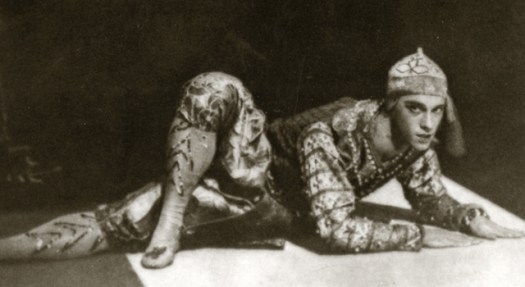
Personally, I think Nijinsky would have been rather impressed with that.

Vaslav-Nijinsky-russian-ballet-icon
Vaslav Nijinsky, as the Golden Slave in Scheherazade, 1888.

—E. Glaze

Lights

For Alice Esty,

In Bengal at the Spring Festival
having carved a small boat
out of the fresh wood,
they walk to the river late at night.
It looks like a vast sliding ebony sea,
and each lights a candle,
sets it at the center
of his own vessel,
and pushes it gently out into the water.

Faster and faster it’s carried away,
thousands  of lights! lights! lights!
rushing past like a field of flickering stars
drifting over the edge of the waters of the earth
into everywhere.
Something in me is about kneeling down
doing that every day.

© Andrew Glaze, 1978, from The Trash Dragon of Shensi

WNYC radio has a 1978 podcast of Glaze reading “Lights”. It is near the beginning of the broadcast:
https://www.wnyc.org/story/andrew-glaze/

In the ’70s I worked in Europe as a professional ballet dancer and my father and I exchanged letters regularly.  The summer of 1976, I came home to visit and my father showed me a page of hand written sheet music by Ned Rorem. It was a piano accompaniment to his poem “A journey”, with the words “For Alice” scrawled in a corner. He explained that a friend had shown his 1974 booklet “A Masque of Surgery” to a female friend who fell in love with the first poem in the book and commissioned Rorem to put it to music. My father played a tape of the song for me. I had no idea who the soprano was.

Not many years ago, I was looking through The Trash Dragon of Shensi when I turned to the first poem in the book (“Lights”) and noticed it was dedicated to “Alice Esty”. My father had no memory of who she was. So I looked on the internet and discovered she was a soprano who married William Esty, the founder of Esty Advertising, and became a patron of the arts. In particular, she commissioned composers to set poems to music for her to sing. Ned Rorem was a favorite. I realized that she was the “For Alice” mentioned on Rorem’s sheet music for “A Journey”, and it was her voice on the tape that I’d heard in 1976.  The logical conclusion was that when his next poetry book came out in 1978 my father decided to dedicate a poem to her as a thank you. When I jogged their memories, my father and stepmom concluded that their link to Alice Esty had been a friend named Walter Perry, from Birmingham.  Later, my stepmom remembered that Walter’s wife Julia was the daughter of Alice and William Esty.

In the 1960’s and 70’s, once a year the Perry’s would come North to Manhattan and host a formal dress party of epic proportions.  The photo below is from that era.

Walter Perry's party

Walter E. Perry Jr. (left), Adriana Keathley Glaze (center), and Andrew Glaze (right), at one of Walter’s annual formal parties in Manhattan.
Photo property of Andrew Glaze Estate.

— E. Glaze

What’s That You Say Cesar?

To Cesar Ortiz-Tinoco

The poet—a political animal?
Yes! Yes!
The way you said that phrase undressed me completely.
There I was naked in a painting of Orozco
holding up a torch which was my own
arm burning above the elbow.
And you yourself were Father Hidalgo
tolling the church-bell of Dolores,
pulling yourself straight up into the air
with your own emotion.
At a moment like that, who would not agree?
yes—yes—a poet is a political animal.

But he is as many other kinds of animal as possible, too.
A suffering animal—delegated
to take on the madness and feckless atrocity of us all,
and of everything.
A hungry animal.
Everything at which he looks with passion
he desires to eat.
A living animal—almost so much more alive
than he or anyone else can have the patience to endure.
A traveling animal, emitting and transmitting
A fighting animal.  He is always down
at the back fence gathering handfuls of ass-manure.
He is able to throw three hundred yards
and strike his enemy in the eye without fail.
A capricious animal.
Here he is sniffing at the holes of bad fortune
and good fortune,
he is trying to decide which will taste better
and is worth digging out of the ground.
A lustful animal.
See how everything he looks at makes him either angry
or in love?

He is always down by the docks helping Venus
out of the sea to be raped.
He is always avenging her rape in a vertigo of righteous rage.

Backs and buttocks and breasts–
he is thrown into spells of deep breathing
and scalded imagination by backs and buttocks and breasts.
By the idea of backs buttocks and breasts!
(male or female).
He falls away constantly
into snatches of mating dances and fertility incantations.

Well then, of course–
when he has been all these kinds of animal,
what you say, too.
Certainly he is in love with the idea of kings and queens,
also presidents, secretaries, first commissar’s
leaders of communes, oligarchists and prime ministers.
He does not disdain dictators.
He has been one, he expects to be one again,
at the first overturn of the state.
Do you see that creature crawling below
about the ballot boxes, snuffling?
It is he.
Also that one standing on the balcony
eating up the cheers.
If there is anyone who loves justice he is there
if there is anyone who loves injustice,
he is there also.
He is in whatever place anyone lives or no-one.
Whatever gave you the idea he was any person in particular?
He was intended to be you.

© Andrew Glaze, from A Masque of Surgery, 1974

Cesar Ortiz Tinoco was a Mexican diplomat who worked at the United Nations in Manhattan. He was the husband of Elizabeth Lambert Ortiz, a poet, writer of cookbooks and other things, and regular contributor to Gourmet Magazine. He was short and compact, while Elizabeth was tall, large boned, full figured, and English. Together, they made one of the most entertaining couples I have ever met. They also greatly enjoyed their cocktails, and came to every house party we had.  Elizabeth consistently wore an attractive cluster of chunky Mexican silver jewelry and they suited her large frame.  Cesar’s position as a diplomat once brought them an invitation to a party at the Irish Embassy.  They laughed as they told us it had been addressed to Mr. and Mrs. Cesar O’rtiz, thereby proving that everyone really is Irish on St. Patrick’s Day.

According to a 1985 interview, my father said that Oscar Williams introduced him to Elizabeth.  All I know is that a photo of my father with Elizabeth was taken on the same day as a photo of my father with Oscar.  My stepmom says that she remembers that poet Hy sobiloff contacted my father to ask him for tutoring on poetry, and help with his own writing.  According to her, the photos of Oscar, my father, and Elizabeth were taken when Sobiloff flew them all out for a weekend at his summer retreat on Long Island (possibly Montauk). She believes that this is when my father first met Elizabeth.

Elizabeth and Cesar hosted one legendary dinner party in 1967, to celebrate her newest effort, The Complete Book of Mexican Cooking.  Elizabeth had spent at least two years testing and perfecting the recipes for the book.  Misguidedly, someone left Craig Claiborne, the food critic for the New York Times, in charge of mixing the margaritas. I think I remember hearing about his “special recipe” during the aftermath.  Everyone had a great time and got up to leave. One guest immediately slid down the stairs on the way out. A second was so dazed she left her glasses in a taxi. A third tripped over on the walk home. Basically everybody in attendance had some sort of accident on their way home other than my parents. My parents made it home safely, and at about 2 AM my father got up to get a glass of water in the kitchen and promptly passed out. The following day was spent trading stories of post-party mishaps.

Elizabeth’s Mexican cookbook contained a recipe for Mexican Wedding Cookies. She’d enjoyed that particular cookie at my parent’s annual Christmas party for years, but still did a taste test of over 10 alternate recipes for comparison. In the end she said, “None of them are as good as yours!”. To this day Elizabeth’s book is still available and page 286 says, “This recipe was given to me by my friend Adriana Keathley Glaze, the dancer and actress”.

For more detail about Elizabeth Lambert Ortiz you can read this link:
https://www.theguardian.com/news/2003/nov/27/guardianobituaries.booksobituaries
Andy with Elizabeth Lambert
Andrew Glaze with Elizabeth Lambert Ortiz, photo by Oscar Williams, June, 1964.

with oscar williams 1964
Oscar Williams with  Andrew Glaze, June 1964.

Norman 1
Photo by Adriana Glaze. Property of the Andrew Glaze Estate.

Rear Right, in profile is Cesar Ortiz Tinoco wearing glasses.  Center, is Writer Norman Rosten wearing a beige jacket. Front, is his daughter Patty in floral dark blue.

— E. Glaze

Ghost Writer

                 In memory of Norman Rosten, 1914-1995

It’s been only five days now, but reliable
as Mozart, he’s already following me around
like a clumsy phantom of winds, reeds,
flies and brown bears. Doppelganger
with the sardonic smile, he took such long pains
to construct himself—a sort of small-sized, shaggy
aircraft-carrier, emitting flights—
now he can laugh, hide behind doors,
make great fun of going where he’s already gone.
What they call Death is ordinary,
respectable and rude. He doesn’t fit.
How can he be giving me prods
and showers of hilarious meaningless threats?
He makes a terrible spook, an incompetent vampire
who’s donated all his blood to poems.

Yet no mistaking who’s slamming the doors,
creaking on the stairs, fluttering in the glass
with the orange juice. Each wandering electricity
is followed by the smell of its own ozone.
You may throw iron filings in the air, as you will,
he’s free of exact diagrams. And honored
as I am to be haunted so, I remember there are—
how shall I say, ever so many others’—
he’ll want to frequent, to honor with his wraithly
touch, that it’s pure luck—pure luck!—
every one of us—to be dogged by the spirit
of such a generous poltergeist, whatever
side of the door the gift is coming from,
whether going out or coming in.

© Andrew Glaze, 2002, from Remembering Thunder

Norman Rosten, was the Poet Laureate of Brooklyn, and became my father’s best friend. Their story began in 1964, when Oscar Williams suddenly died.  Oscar was a poetry anthologist with several highly successful volumes that were standard at US high schools and colleges. Someone introduced them, they became friendly and eventually Oscar asked why my father never showed him any of his poems. When my father obliged, Oscar shared them with his poet friend Elizabeth Lambert and reported back that they were “Impressed”.  In a 1985 interview with Steven Ford Brown, my father said that it was Williams who’d nagged him to put a manuscript for a book together.  I remember that my father said Oscar was planning to include his work in the next anthology.  I met Williams when he came to dinner at our apartment one evening.  But most importantly, he personally took the manuscript of my father’s poems to Trident Press at Simon & Schuster and told them to publish it. Trident was the publisher of his own books, and he was an advisor/editor there.  Oscar began overseeing the editing of the book and my father was blissfully happy. And then, just as suddenly as the burgeoning friendship began, Oscar was gone.  My father was in shock.  Then a miracle happened. Trident Press had another poet advisor by the name of Norman Rosten. They turned to him for advice and he said, “Publish it!”  He was also impressed.

Norman was a special person, warm, gregarious, and with a sense of humor that matched my fathers. He lived in a huge rent controlled apartment in a Brooklyn brownstone building that he shared with his wife Hedda and daughter Patricia. It was in fact such a great apartment that later in life when he was an aging widower, his young landlord, who longed to live there himself, offered a trade to him. In exchange for Norman giving up his rent controlled lease, he would receive the gift of ownership of a nearby studio condo apartment. Norman took him up on the offer.

Norman was full of surprises. Besides doing screenplays, stage plays, poems, and a children’s book, in 1973 he came out with the book Marilyn; an Untold Story, revealing his families close friendship with Marilyn Monroe. In fact, Norman was the last person Marilyn spoke to on the night she died.  In 1993, he wrote the libretto for an opera titled “Marilyn” which was premiered by the City Opera at Lincoln Center. But his real specialty was sending postcards to friends with humorous cartoon balloon captions drawn above postage stamps of past presidents.

In 1979 Norman published a poem about my father in his book Norman Rosten Selected Poems.  It was titled  “The Split Bicycle”.  Apparently Norman was amused by the fact that my father’s latest purchase was a bike for city residents who wanted to easily store their bike in their workplace or apartment.  The wheels were on the small side, it quickly dismantled into two halves, and it was easy to carry. At that point in time a lot of people in NYC were riding them.  The poem is posted under the “Friends” Menu on the Home Page.

One winter in the 1990’s, when he was recovering from heart problems, he flew to Miami to stay with my father and stepmom for a while.  When I was there at Christmas my father told me about the visit and said, “We have to do whatever we can to keep Norman healthy. The world is a better place with him in it”. He mentioned that Norman had looked frail when he arrived, but enjoyed going to the beach, relaxing, and looked a bit better when he left.

When Norman died in 1995, I can truly say that my father was heartbroken.  Yet, what came out in the poem was his fondness for Norman, the shared sense of humor, and the twinkling eyed personality of his late friend.

Andrew Glaze 1970's, visiting writer and good friend Norman RostenSag Harbor Lovers July '75
Visiting Norman and Hedda Rosten.  On the playful photo of Glaze with his wife Hedda, Rosten wrote, “Stop it you two!” on the front and “Sag Harbor Lovers, July 1975” on the back.  Photos by Norman and Hedda Rosten. Property of the estate of Andrew Glaze.
The postcard below was sent to me by Norman, in 1969.
“I hear Betsy’s going to England.”
“I hope she remembers we won our independence.”
IMG_20171207_0001

For Christmas of 1974, Norman gave my father a copy of the Cloisters Museum book The Belles Heures of Jean, Duke of Berry,  with the inscription:
“To Adrianna and Andy,
Best Wishes for ’95
(more like plate 17, not 18!)
…and love besides,
Xmas ’74          Hedda and Norman

Number 17                                         Number 18
         
(from the book published by Georges Braziller in 1974)

IMG_20210307_0001
Norman Rosten and Andrew  Glaze in a backyard in the 1970’s.
Photo by Adriana Glaze, property of the Andrew Glaze Estate.
IMG_20161022_0001 (2)
1970’s photo of Norman Rosten, by Adriana Glaze.  Property of the Andrew Glaze Estate.

— E. Glaze

I Come In Late

I come in late.  My daughter has gone to sleep.
There is an army of old shoes scattered,
they seemed like verve this morning,
tonight they have suddenly grown old.
There is a cold air from the window over her head,
she likes being friendly with the outside,
she is not so lonesome sleeping in my bed,
often she lies awake in the back
where her mother made her the princess bed with curtains
and stars, listening to the people next door
cursing each other.  She says her mother told her
people’s religion keeps them together
all life long, shouting at each other.
I get lonesome back there with strangers,” she says,
she misses her little brother complaining in the night.
She likes to see her mother twice a week
and has a witch who lives under her bed with a buzz saw.
She has to twist and turn to protect her feet.
I wish I had a witch under my bed with a buzz saw
who’d cut me clean in half while I was asleep.

Andrew Glaze, 1965, from DAMNED UGLY CHILDREN


My father wrote this poem during the separation and divorce from my mother.  It’s very visceral, and at the same time very literal.  That first year was extremely hard and my father and I kept each other going.  

I was 11 and my primary residence was with my father, while my 3 year old brother stayed with our mother. We still lived in the same Greenwich Village apartment at 173 Bleecker Street, with living room windows that looked out on the street below. When you first entered the apartment it was into the kitchen. There was a make shift closet in the opposite corner with a curtain across it. Shoes were always spilling out at the bottom.

My parents had given me the only bedroom in the apartment and one summer, while I was visiting Birmingham, my mother removed the long sliding doors from the closet and placed my twin sized bed inside it.  Using gold paint she drew interlocking circles on the wall at the back (“stars”), and draped diaphanous curtains across one end. It was undeniably my Princess Bed. I was almost 8, and quite in awe. I did silently wonder what I would do for a closet, but then she showed me the free standing wardrobe she’d built for me.

When my brother was born we became roommates. I had the far end and he had the end closest to the rest of the apartment. A partition divided us, but I could hear every sound he made. When he was a newborn, it was easier for me to hear him than it was for my parents and I was often the one who had to tell them he was crying. Sometimes it was easier to change his diaper myself just to speed up the process. Despite it all, when my mother and brother were no longer with us, I missed them.  Occasionally, when I was feeling down, I would ask to cuddle up to my dad on the fold out bed in the living room.

My father grew up in a family that was very gung ho on fresh air, and he carried on the custom. There was a window near the head of my bed, Manhattan apartments are notoriously overheated, and my window was always open at night. There was only one problem with this, which was that the window opened onto an “Air Shaft”. In Manhattan, this is a legally required open gap area between two buildings that would otherwise be completely butted up alongside each other. An air shaft provides fresh air, some degree of light, and a reverberation of noise that would make a movie sound engineer proud. Add a married couple who have screaming arguments with each other at night to this equation and they might as well be standing in the room with you.  My father was accurate in his account of what my mother told me when I asked why our neighbors stayed together when they clearly hated each other.

Other than nail biting, the one expression of anxiety I had was a witch living under my bed. She’d been there for several years. She did indeed have a buzz saw and I had to keep changing my position to prevent being dismembered, at least until I fell asleep. Whenever I had to go to the bathroom at night, I would also cleverly avoid having my feet cut off at the ankles by taking a flying leap off of and then back onto my bed.

I remember finally telling my father about my witch. Fortunately, she stayed behind when my father married my stepmother and we moved out of the apartment.

— E. Glaze


173 Bleecker Street
173 Bleecker Street, between Sullivan and MacDougal Streets.
The store downstairs was a launderette when we lived there. We were on the 4th level if you count the ground level. Our two windows were the left side of the fire escape.